Most homeowners assume cast iron pipes are built to last a century. That’s what the national data says — and in a dry climate, it might even be true. But Brevard County isn’t a dry climate. It’s a coastal, humid, salt-saturated environment that quietly dismantles cast iron from both the inside and the outside, often decades ahead of schedule.
If your home was built before 1975 and you’re dealing with slow drains, recurring backups, or a plumber who keeps suggesting the same temporary fix, the pipes themselves may be the problem. Here’s what’s actually happening — and what changing cast iron pipe to PVC looks like in this part of Florida.
Why Brevard County Homes Fail Cast Iron Pipe Faster Than the Rest of the Country
The national expectation for cast iron pipe lifespan is somewhere between 75 and 100 years. In Florida, that number shrinks to 25 to 40 years — and in coastal Brevard County, some pipes fail even sooner.
Cast iron corrodes from two directions simultaneously here. Salt-laden air and moisture-rich soil attack the outside of the pipe while hydrogen sulfide gas — produced naturally by waste inside your drain lines — attacks from within. That gas reacts with moisture to form sulfuric acid on the interior pipe walls. Over time, the surface erodes, narrows, and eventually collapses. The whole process happens invisibly, under your slab or inside your walls, for years before you see a single symptom.
The Space Coast’s Specific Role in Accelerating Cast Iron Corrosion
Brevard County’s geography makes this problem worse than it is almost anywhere else in the state. The county sits along a narrow Atlantic coastal strip, with the Indian River and Banana River lagoons running alongside much of it. Merritt Island, sandwiched between those two bodies of water, is surrounded by salt-rich air and moisture on all sides. Cocoa, Rockledge, Titusville — the same story.
The soil is sandy and shifts with rainfall and tidal changes. Cast iron is rigid and brittle. It doesn’t flex. When the ground moves, the pipe doesn’t — and joints crack or separate at exactly the wrong moment.
This matters because many of the homes in these communities were built during the Space Coast construction boom of the 1960s and early 1970s, when Kennedy Space Center and the Apollo program were drawing workers and families to Brevard County by the thousands. Those homes were built with cast iron drain lines — because that was the standard until PVC took over in 1975. A home built in 1968 in Cocoa, FL or Rockledge, FL is now sitting on pipes that are more than 55 years old, in one of the most corrosive environments in the country.
If cast iron fails at 25 to 40 years in Florida’s climate, a 55-year-old pipe isn’t aging — it’s already borrowed time. And the problem with cast iron corrosion is that it rarely announces itself dramatically. You get slow drains. You get a smell that comes and goes. You get a backup that the plumber snakes out, and then three months later, you’re calling again.
Each of those service calls treats the symptom. None of them address the pipe. An estimated 2.5 million Florida homes may be dealing with some form of premature cast iron failure. What’s surprising is how many homeowners are still waiting for a catastrophic failure before they act — not realizing that by the time the pipe actually collapses, the cost of remediation can reach $30,000 to $50,000 or more when water damage and floor repair are factored in.
Cast Iron Drain Replacement: Repair or Replace?
This is the question most homeowners are wrestling with when they start researching this topic. You’ve had a plumber out. Maybe they’ve snaked the drain a few times. Maybe they’ve mentioned replacement but you want a second opinion before you commit to that kind of project.
The repair-or-replace decision comes down to one thing: what’s actually happening inside the pipe. Snaking a drain clears the immediate blockage, but it doesn’t address the corroded, roughened interior surface that caused the buildup in the first place. Cast iron that’s been eaten away from the inside has an uneven, pitted surface that catches grease, hair, and debris far more readily than a smooth pipe would. You can clear it today and have the same problem in a few months because the pipe itself is the problem.
The honest answer is that a camera inspection is the only way to know for certain. A camera run through your drain lines shows you exactly what’s there: the degree of corrosion, any cracks or separations at joints, any sections that have already partially collapsed. That documentation changes the conversation from “trust me” to “here’s what we found.”
For cast iron drain replacement specifically, the scope of work depends heavily on which pipes are affected. Horizontal under-slab drain lines and the vertical drain stack inside the home have different failure patterns and different replacement approaches. Under-slab lines are the more common culprit in Brevard County’s pre-1975 homes, but the stack — which handles the highest volume of waste from every fixture in the house — can show symptoms first.
Sewer odors that seem to come from nowhere, or slow drains on multiple floors at the same time, often point to the stack rather than the horizontal lines. What we find consistently is that homeowners who’ve been in their homes for 20 or 30 years have often been managing these symptoms for years without connecting them to the pipes. Once a camera inspection shows them what’s actually there, the decision usually becomes straightforward.
Replace Cast Iron Drain Pipe with PVC: What the Process Actually Looks Like
For homeowners who haven’t been through a repipe before, the process can feel intimidating — especially when you’re imagining weeks of construction, jackhammered floors, and no working bathrooms. The reality is more manageable than that.
Most residential cast iron pipe replacement projects in Brevard County take two to five days, depending on the scope of the work and which method is used. The starting point is always a camera inspection and a written estimate. You know exactly what’s being replaced, why, and what it will cost before we touch a pipe. From there, the method depends on what the inspection reveals.
How Cast Iron Pipes Are Cut Out and Replaced with PVC
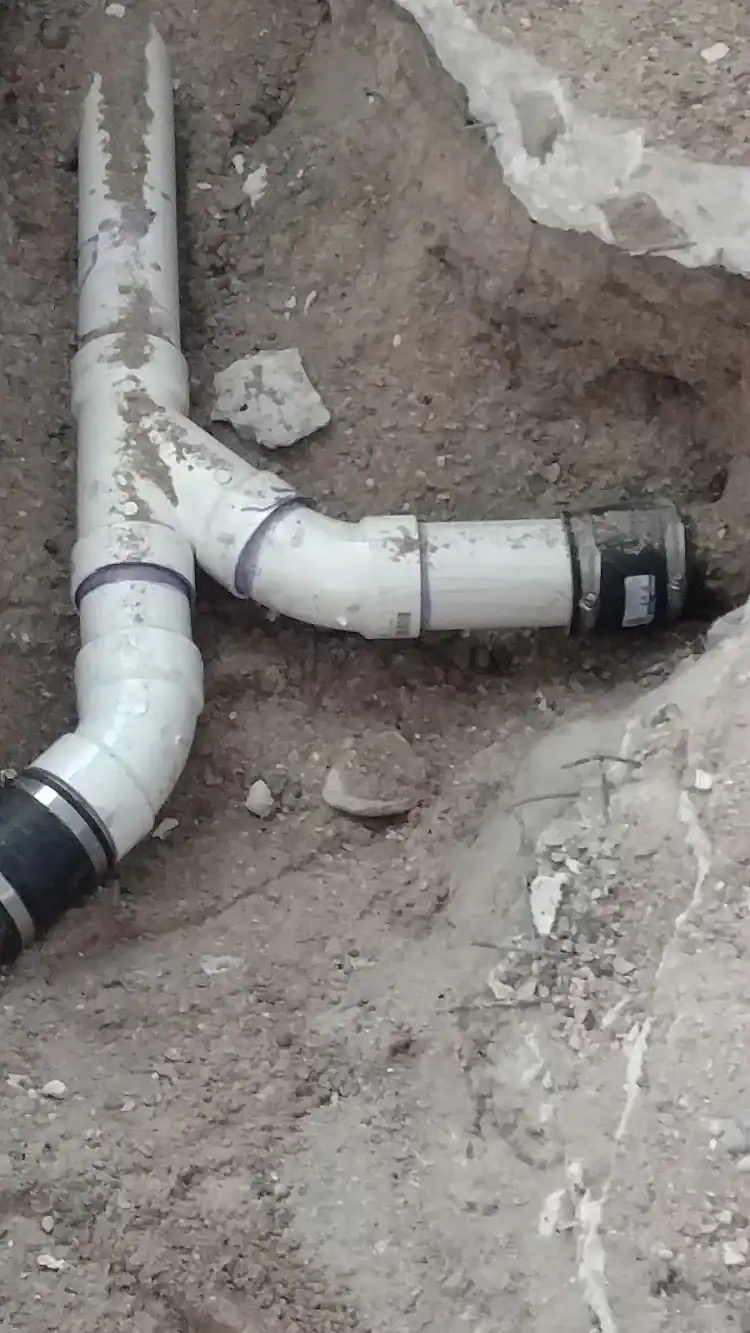
The mechanical process of changing cast iron pipe to PVC is more straightforward than most homeowners expect. Cast iron is cut at the connection points using a snap cutter or angle grinder, and the old pipe is removed in sections. PVC is then fitted to the existing system using what’s called a no-hub coupling — a flexible rubber connector that creates a watertight seal between the old cast iron at the transition points and the new PVC runs.
For horizontal under-slab drain lines, access typically requires cutting through the concrete slab. But it’s worth knowing that not every situation requires full excavation. Trenchless options exist for certain configurations, and a camera inspection determines whether your specific layout qualifies. Where excavation is necessary, we work in targeted sections rather than across the entire floor — and the concrete is restored before the job is complete.
For the vertical drain stack — the main pipe that runs from your roof vent down through the home, connecting every fixture — access is usually through the walls. We open sections of drywall, remove the old cast iron stack, and install PVC in its place. The stack is then pressure tested to confirm the system is sealed and functioning correctly before walls are closed back up.
The entire process is permitted work in Florida. We pull the permit, coordinate the county inspection, and make sure everything meets current Florida building codes. That documentation matters — not just for code compliance, but for your own protection when it comes to insurance and resale. A permitted, inspected repipe is a documented asset.
Replacing Cast Iron Stack with PVC: What Homeowners in Brevard County Should Know
The drain stack doesn’t get as much attention as under-slab lines in most conversations about cast iron replacement, but it’s often where problems show up first. The stack handles concentrated waste from every fixture in the home — toilets, sinks, showers — and it’s exposed to the highest levels of hydrogen sulfide gas as a result.
In a home with original 1960s or 1970s cast iron, the stack has been absorbing that internal corrosion for decades. Symptoms that point specifically to the stack include sewer gas odors that seem to drift through the home without a clear source, gurgling sounds from drains when another fixture is in use, and slow drains that affect multiple floors simultaneously rather than just one bathroom or one fixture.
Replacing the cast iron stack with PVC is a contained project compared to a full under-slab repipe. It typically doesn’t require any concrete work — just wall access at the points where the stack connects to fixture drain lines and where it exits through the roof. The new PVC stack is lighter, easier to work with, and once it’s in, it won’t corrode.
The smooth interior surface won’t trap buildup the way corroded cast iron does. And because PVC doesn’t react to hydrogen sulfide, the internal corrosion cycle stops entirely. For Brevard County homeowners, there’s another consideration worth raising: the insurance and lending environment in Florida has shifted significantly. Some carriers are scrutinizing cast iron pipe status during policy renewals, and some lenders are flagging it during real estate transactions.
If you’ve received a notice from your insurer or a flag on a home inspection report, a documented camera inspection — even if it shows the pipes are still serviceable — gives you something concrete to present. And if replacement is warranted, a permitted, inspected repipe gives you documentation that the issue has been resolved. That matters in a market where median home values in Brevard County have climbed to $372,900.
Ready to Find Out What’s Actually in Your Pipes?
The decision to change cast iron pipe to PVC isn’t one most homeowners make impulsively. It’s a significant project, and you deserve a clear picture of what you’re dealing with before you commit to anything. That starts with a camera inspection — not a guess, not a quote based on the age of your home, but an actual look at what’s happening inside your specific drain system.
If your home was built before 1975 anywhere in Brevard County — Cocoa, FL, Rockledge, FL, Merritt Island, Titusville, FL, Melbourne, FL, or anywhere else on the Space Coast — the pipes are worth inspecting. Florida’s climate doesn’t give cast iron the lifespan the rest of the country expects, and the longer a failing system goes unaddressed, the more expensive the eventual fix becomes.
Drain Wizard has been doing this work in Brevard County since 2007. If you’re ready to find out what’s actually going on under your slab or inside your walls, we’re the people to call.
Get a straight answer on your cast iron pipes
Drain Wizard has replaced and repiped cast iron across Brevard County since 2007. We camera-inspect first, show you exactly what's failing, and give you one clear price, no guessing. See our cast iron pipe replacement service →