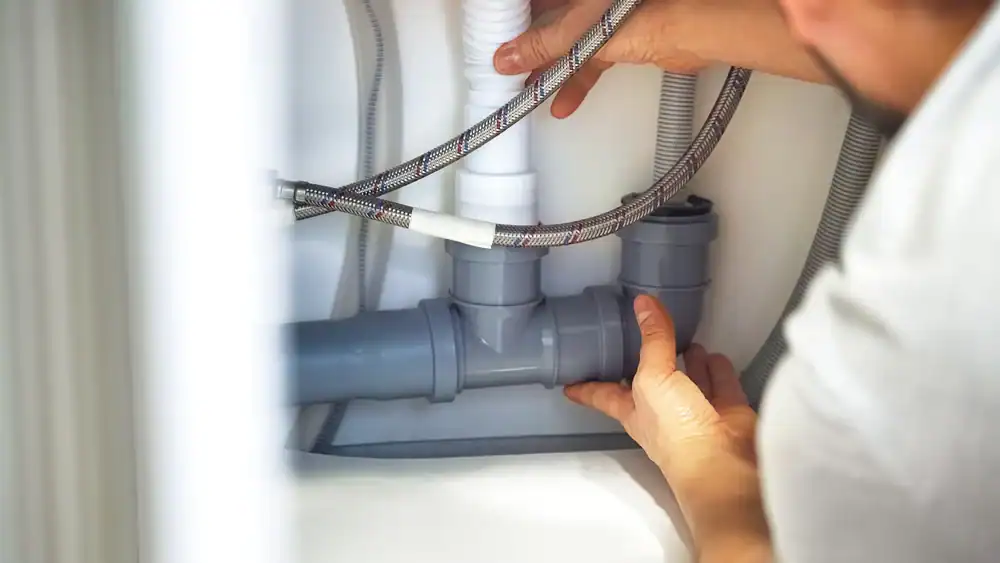
If your home is in Cocoa, Merritt Island, Rockledge, Melbourne, or anywhere else on the Space Coast, there’s a decent chance the sewer pipes running beneath your slab are original — cast iron or Orangeburg, installed when your neighborhood was new and NASA was putting men on the moon. Those pipes were never meant to last forever. In Florida’s humid, salt-rich coastal climate, they often don’t even make it to 30 years. This guide covers what drain pipe replacement actually involves, what it costs, when repair makes sense versus full replacement, and what to look for in a contractor before you let anyone dig.
Sewer Smell in Your House? It Might Not Be a Simple Clog
A sulfur or sewage smell coming from your drains is one of the earliest warning signs that something is wrong deeper in the system. It’s easy to assume it’s just a dry P-trap or a slow drain that needs a quick fix. Sometimes it is. But when the smell is persistent, shows up in multiple rooms, or comes with gurgling sounds when you run water elsewhere in the house, you’re likely looking at a main line issue.
Cast iron pipes corrode from the inside out. As the metal deteriorates, it releases hydrogen sulfide gas — the source of that rotten egg smell — and the rough interior surface starts catching grease, debris, and roots. By the time the smell is noticeable, the damage has usually been building for years.
Main Sewer Line Clog vs. Individual Drain Problem — How to Tell the Difference
A single clogged drain at one fixture — a kitchen sink drain backed up after a holiday dinner, a bathroom drain clogged with hair — is usually an isolated issue. You snake it, it clears, and that’s the end of it. A main sewer line clog is a different animal entirely.
The giveaway is when multiple drains start acting up at the same time. Your kitchen sink drain backs up while you’re running the washing machine. Your toilet gurgles when you take a shower. Water comes up in the floor drain when you flush. These aren’t coincidences — they’re all connected to the same main line, and when that line is compromised, every fixture downstream feels it.
In Brevard County, where so many homes were built during the Apollo-era construction boom of the 1960s and early 1970s, a main drain clog that keeps coming back is rarely just a clog. It’s often a symptom of pipe channeling — a cast iron failure mode where the bottom of the pipe gradually deteriorates from constant water flow, creating a trough that fills with debris and eventually collapses. Snaking provides temporary relief, but it doesn’t fix the pipe itself.
Orangeburg pipe presents a different problem. Used widely in Brevard County homes built between the 1960s and early 1980s, Orangeburg is a tar-paper-based material that was cheap and easy to install at the time. Over the decades, it absorbs moisture, softens, and eventually deforms — creating low spots called bellies where waste pools and blockages become chronic. Once Orangeburg starts going, it doesn’t recover. Repair is a temporary patch on a material that’s already past the end of its functional life.
If you’re dealing with recurring backups, slow drains throughout the house, or a clog that keeps coming back no matter how many times it’s been cleared, the honest answer is that you probably need more than a rooter service. You need someone to put a drain camera inspection in the line and show you what’s actually happening.
Kitchen Sink Drain Clogged Again? When Recurring Drains Signal a Bigger Problem
A kitchen sink drain that clogs repeatedly — even after professional snaking — is frustrating in a way that’s hard to explain to someone who hasn’t dealt with it. You call a plumber, they clear it, it’s fine for a few weeks, and then it’s back. Most homeowners assume it’s grease buildup or bad habits at the sink. That’s sometimes true. But when the same drain keeps failing, or when a bathroom drain clogged on one end of the house starts backing up around the same time as the kitchen, you’re likely dealing with a main line problem, not a fixture problem.
In older Brevard County homes, cast iron drain pipes develop a rough, pitted interior surface as they corrode. That texture catches everything — grease, hair, soap residue, small debris — far more aggressively than smooth PVC would. Over time, the buildup becomes structural. You can clear the obstruction, but you can’t restore the pipe surface. The clogs come back faster and faster until the pipe simply can’t be kept clear anymore.
The same logic applies to a bathroom drain clogged from a combination of hair and soap scum in a home where the pipes are already partially obstructed by corrosion. What should be a minor, routine clearing becomes a recurring service call because the underlying pipe condition keeps accelerating the problem.
This is why a drain camera inspection matters so much before recommending any course of action. An inspection drain camera run through the main line shows exactly what’s happening — channeling, root intrusion, pipe belly, partial collapse — and gives you something concrete to base a decision on. It’s the difference between guessing and knowing.
Replace Sewer Line Without Digging — What Trenchless Sewer Pipe Repair Actually Means
The single biggest reason Brevard County homeowners delay sewer line replacement is the mental image of their yard being torn up. A trench running from the house to the street, through the landscaping, across the driveway — it sounds like a weeks-long nightmare. That picture is outdated for most residential sewer jobs.
Trenchless sewer pipe repair — specifically pipe bursting — replaces your main sewer line through two small access points. No trench. No excavator tearing through your yard. The old pipe gets broken apart as a new HDPE pipe is pulled through in its place. HDPE is heat-fused into one continuous length with no joints, which means no future root intrusion points and no seams for soil to work into over time.
Trenchless Sewer Lateral Replacement — Is It Right for Your Brevard County Property?
Trenchless sewer lateral replacement is particularly well-suited to the kinds of properties common throughout Brevard County — homes in Merritt Island and Cocoa Beach with mature landscaping and outdoor living spaces, homes in Rockledge and Melbourne with long driveways sitting directly over the sewer line path, and barrier island properties where the soil and salt environment make open trenching a more disruptive undertaking.
Pipe bursting works best when the existing pipe, though deteriorated, still has enough structural integrity to guide the bursting head through. For severely collapsed lines or pipes with major offsets, traditional excavation may still be necessary in sections. A camera inspection beforehand is what determines which approach is appropriate — which is why skipping that step to save a few hundred dollars rarely makes sense on a job that could run several thousand.
The other trenchless method worth knowing is cured-in-place pipe lining, or CIPP. Rather than replacing the pipe, a resin-saturated liner is inserted and cured inside the existing pipe, creating a new smooth interior surface. CIPP is best suited for pipes that are damaged but not collapsed — it restores function without requiring any excavation. The tradeoff is that it slightly reduces the pipe’s interior diameter and isn’t appropriate for pipes that have already lost their structural shape.
For most Brevard County homeowners with aging cast iron or Orangeburg sewer lines, pipe bursting is the more common recommendation because those materials tend to be too far deteriorated for lining alone to address. But the right answer depends on what the camera shows, not on a general preference for one method over another.
Replacing Clay Sewer Pipe Without Digging — What Brevard County Homes Built on Sandy Soil Need to Know
Clay pipe was used in some older Brevard County sewer systems, particularly in connections to municipal lines. Like cast iron and Orangeburg, clay pipe has a finite lifespan — and in Florida’s shifting sandy soils, it tends to reach that limit faster than in more stable ground. Clay is brittle. It cracks under ground movement, and once root systems find a crack, the intrusion accelerates quickly.
Replacing clay sewer pipe without digging follows the same trenchless pipe bursting process described above, provided the line hasn’t collapsed to the point where the bursting head can’t pass through. The reason this matters specifically for Brevard County homeowners is the soil itself. Much of the Space Coast is built on sandy, loosely packed ground with a high water table — particularly in communities closest to the Indian River Lagoon and the Atlantic coast. That soil shifts. It doesn’t hold a pipe in place the way denser soil does in other parts of the country.
A clay pipe that was installed level in 1968 may have developed a belly — a low spot where waste pools — simply from decades of gradual soil movement beneath it. Trenchless methods address the pipe. They don’t address the soil conditions that caused the problem. A good contractor will be honest about both.
One more thing worth noting for slab-on-grade homes — which is most of Brevard County — is that some portion of your drain system runs beneath the concrete foundation itself. Under-slab pipe replacement is a more involved process regardless of method, and the cost reflects that. It’s not a reason to delay, but it is a reason to get a clear diagnosis before assuming the scope of work.
Drain Pipe Replacement in Brevard County — What to Do Next
If your home was built before 1975 and you’ve been dealing with recurring slow drains, sewage smells, or backups that keep coming back, the pipes themselves are the most likely explanation. Florida’s coastal climate is hard on cast iron and Orangeburg — harder than the national averages suggest — and by the time symptoms show up at the surface, the damage underground is usually well advanced.
The right first step isn’t committing to a full replacement. It’s a drain camera inspection. It shows you exactly what’s in the ground, gives you a real basis for whatever decision comes next, and costs a fraction of what a misdiagnosed repair job can run.
We’ve been doing this work in Brevard County since 2007. We’re licensed, insured, veteran-owned, and every job is personally overseen by the owner. If you want to know what’s actually going on with your pipes, give us a call.
Get a straight answer on your cast iron pipes
Drain Wizard has replaced and repiped cast iron across Brevard County since 2007. We camera-inspect first, show you exactly what's failing, and give you one clear price, no guessing. See our cast iron pipe replacement service →